An effective anti-aging skincare routine does not need to be complicated. You do not need dozens of products, expensive treatments, or every new beauty trend to care for your skin. The most important step is choosing ingredients that support hydration, protection, brightness, and a smoother-looking complexion.
Visible signs of aging can include fine lines, dryness, uneven tone, dark spots, rough texture, and loss of firmness. These changes are natural, but daily skincare habits can help your skin look healthier and more refreshed over time.
The best anti-aging routine combines gentle cleansing, targeted ingredients, moisturizer, and daily sunscreen. When these steps work together, they can support the skin barrier and help maintain a more radiant appearance.
This guide explains the most useful anti-aging skincare ingredients and how to include them in a simple routine.
Why ingredients matter in anti-aging skincare
Skincare products are only as good as their formulas. Attractive packaging can catch your attention, but the ingredient list tells you what the product may actually do for your skin.
Anti-aging skincare should focus on three main goals: protecting the skin, supporting hydration, and improving the appearance of texture and tone. Some ingredients help attract moisture. Others support the skin barrier, brighten dull areas, or encourage smoother-looking skin.
A good routine should also be realistic. Strong products can be helpful, but using too many active ingredients at once may cause irritation. Redness, dryness, burning, and peeling can make the skin look worse instead of better.
Retinol for smoother-looking skin
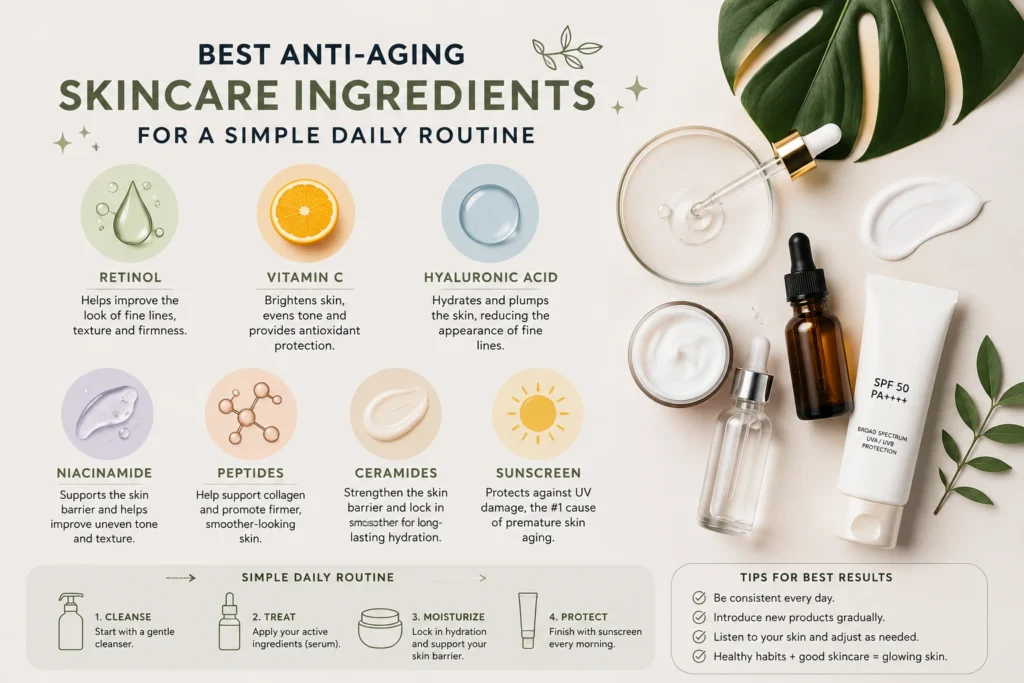
Retinol is one of the most popular anti-aging ingredients. It belongs to the vitamin A family and is often used in night creams, serums, and targeted treatments.
Many people choose retinol because it may help improve the appearance of fine lines, rough texture, uneven tone, and dullness over time. It is especially common in routines for mature skin or skin that looks tired.
Retinol should be introduced carefully. Start with a low-strength product two or three nights per week. Apply it after cleansing and before moisturizer, unless the product instructions say otherwise.
If your skin feels dry or sensitive, use the moisturizer sandwich method. Apply a light layer of moisturizer, then retinol, then another layer of moisturizer. This can make retinol easier to tolerate.
Vitamin C for brightness and antioxidant care
Vitamin C is a common ingredient in brightening and anti-aging skincare. It is often used in morning serums because it supports a more radiant-looking complexion and antioxidant protection.
Many people use vitamin C to improve the appearance of dullness, uneven tone, and dark spots. It can also complement sunscreen in a daytime routine, although it should never replace sun protection.
Vitamin C products can vary in strength and stability. Some formulas feel powerful but may irritate sensitive skin. Others are gentler and better suited for beginners.
Apply vitamin C after cleansing and before moisturizer. In the morning, follow with sunscreen. This routine can support a brighter, fresher appearance over time.
If your skin is sensitive, start with a lower-strength formula or use it every other morning. Store vitamin C products according to the label, because some formulas can lose effectiveness when exposed to light or air.
Hyaluronic acid for hydration
Hyaluronic acid is a hydration-focused ingredient that works well in many skincare routines. It helps attract water to the skin, which can make the face look plumper, fresher, and more comfortable.
Dry or dehydrated skin can make fine lines look more visible. By supporting hydration, hyaluronic acid can help the skin appear smoother and less tired.
This ingredient is usually easy to use. Apply a hyaluronic acid serum after cleansing, then seal it with moisturizer. It can be used in the morning, evening, or both.
Hyaluronic acid works best when paired with a moisturizer. Without a cream or lotion on top, hydration may not last as long, especially in dry environments.
Look for hyaluronic acid in serums, moisturizers, masks, and eye creams. It is a useful ingredient for beginners because it supports comfort without feeling too strong.
Niacinamide for balanced-looking skin
Niacinamide is another versatile ingredient for anti-aging routines. It is a form of vitamin B3 and is often used in serums, moisturizers, and barrier-support products.
This ingredient may help improve the appearance of uneven tone, visible redness, enlarged-looking pores, and excess oil. It can also support the skin barrier, which is important for skin that feels dry or stressed.
Niacinamide is usually well tolerated, making it a good option for many skin types. It can be used in the morning or evening and pairs well with moisturizers and sunscreen.
For a simple routine, choose a moisturizer or serum with niacinamide. This allows you to support your skin without adding too many steps.
People with oily, combination, sensitive, or mature skin may all benefit from niacinamide. It is especially useful when your goal is a balanced, smoother-looking complexion.
Peptides for firmness support
Peptides are small chains of amino acids used in many anti-aging creams and serums. They are often included in products designed to support firmness, smoothness, and a refreshed appearance.
Peptide products are popular because they are usually gentle. Unlike stronger ingredients such as retinol or exfoliating acids, peptides are often easier to include in a daily routine.
A peptide serum or moisturizer may be useful for people who want a supportive anti-aging product without too much irritation. It can be applied in the morning or evening, depending on the formula.
Peptides work best when combined with other good skincare habits. Use them with moisturizer, sunscreen, hydration, and a balanced lifestyle.
Ceramides for barrier care
Ceramides are lipids naturally found in the skin barrier. They help the skin stay hydrated, comfortable, and protected from external stress.
As skin becomes dry or sensitive, barrier support becomes more important. A weak barrier can make the skin feel tight, rough, irritated, or more reactive to active ingredients.
A moisturizer with ceramides can help support daily comfort. It is especially useful if you use retinol, vitamin C, or exfoliating acids, because these ingredients may sometimes cause dryness.
Ceramides work well for dry, sensitive, and mature skin. They are commonly found in creams, lotions, and barrier-repair moisturizers.
If your anti-aging routine feels too harsh, simplify it. Use a gentle cleanser, ceramide moisturizer, and sunscreen for a few days before adding stronger products again.
Sunscreen as the most important anti-aging product
Sunscreen is one of the most important products in any anti-aging routine. UV exposure can contribute to dark spots, uneven tone, rough texture, fine lines, and premature visible aging.
A broad-spectrum sunscreen helps protect against UVA and UVB rays. For daily use, many people choose SPF 30 or higher. Apply it every morning as the last step of your skincare routine.
Sunscreen should be used even on cloudy days. UV rays can still reach the skin, especially during outdoor activities or long periods near windows.
Choose a sunscreen you enjoy wearing. Lightweight, tinted, mineral, gel, moisturizing, and invisible formulas are available. The best sunscreen is the one you will apply consistently.
If you use retinol, exfoliating acids, or brightening products, sunscreen becomes even more important. These products work better in a routine that protects the skin daily.
How to build a simple anti-aging routine
A simple anti-aging routine should protect your skin in the morning and support repair at night.
Morning routine:
- Gentle cleanser
- Vitamin C or niacinamide serum
- Moisturizer
- Broad-spectrum sunscreen
Evening routine:
- Gentle cleanser
- Retinol or peptide serum
- Ceramide moisturizer
You do not need to use every ingredient every day. A beginner can start with sunscreen in the morning and retinol two or three nights per week. Then, add vitamin C or niacinamide when the skin feels comfortable.
Avoid starting retinol, vitamin C, and exfoliating acids all at once. Introduce one product at a time and give your skin at least one or two weeks to adjust.
If irritation appears, pause strong actives and focus on moisturizer, sunscreen, and gentle cleansing.
Recommended anti-aging skincare products
A practical anti-aging skincare routine can include a few essential product types.
Start with a gentle cleanser that does not leave your face feeling tight. Add a vitamin C serum for morning brightness, or choose niacinamide if your skin needs balance and barrier support.
Use a moisturizer with ceramides, peptides, hyaluronic acid, or glycerin. These ingredients help support comfort and hydration.
At night, consider a low-strength retinol product if your skin tolerates it. Use it slowly and consistently. If retinol feels too strong, a peptide cream may be a gentler choice.
Daily sunscreen should be non-negotiable. Choose a broad-spectrum formula that fits your skin type and feels comfortable under makeup or on bare skin.
A strong routine does not need to be crowded. With the right ingredients, you can care for fine lines, dullness, dryness, uneven tone, and texture while keeping your skincare simple.
Explore anti-aging skincare products such as vitamin C serums, retinol creams, peptide moisturizers, hyaluronic acid serums, ceramide creams, and daily sunscreen to build a routine that supports smoother, brighter, and healthier-looking skin.